How to solve a word search in record time: 5 visual tricks
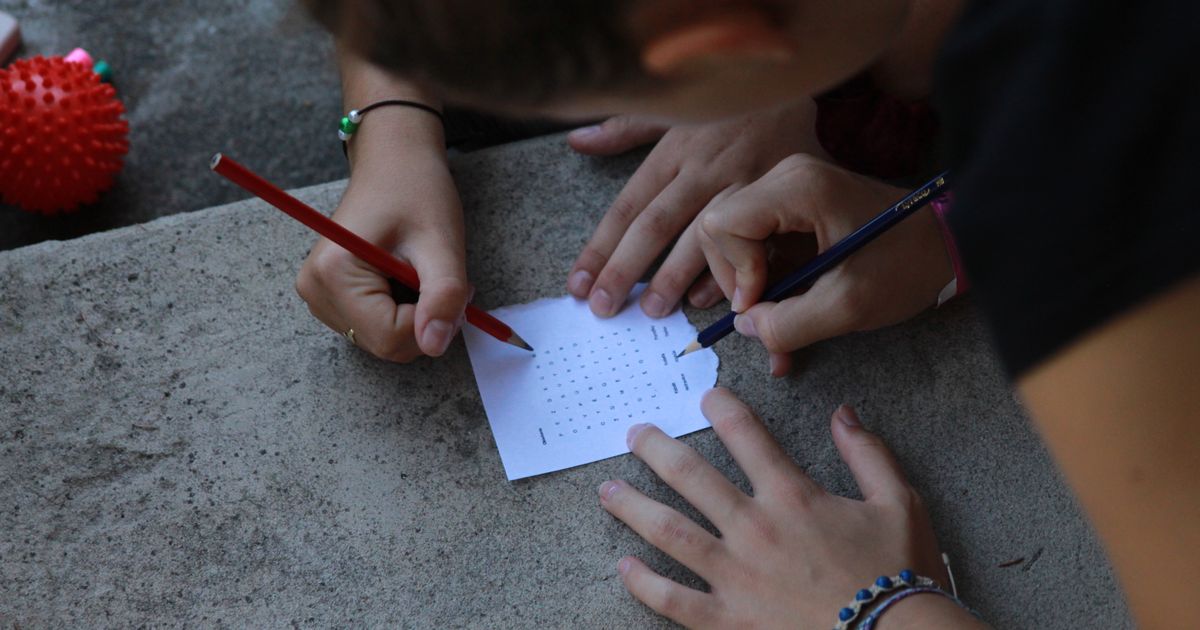
We've all stared at a word search unable to find the word that was right in front of us. Speed at solving them isn't luck or exceptional eyesight: it's visual scanning technique, and it can be trained. Here are 5 tricks good solvers use to cut their time noticeably. Try them right now in our free online word search.
Trick 1: start with the rare letters
Instead of hunting for the whole word, look first for its least common letter. Words containing Z, X, Q, K, J or W are much easier to spot, because those letters appear rarely in the grid and "jump out".
If you have to find "JACKPOT", don't sweep the entire grid: look for the J or the K, which will be just a couple of spots on the whole board, and from there check whether the word forms. It's the fastest way to shrink the search space.
Trick 2: scan by letter pairs, not single letters
Your brain recognises combinations faster than isolated letters. Instead of hunting for the "C" in "CLOUD", look for the "CL" start; instead of the "L" in "YELLOW", look for the double "LL".
Vowel pairs (EA, OO, IE, AU) and common digraphs (TH, CH, SH, QU) are excellent visual anchors: as soon as you spot the pair, you have the word's starting point.
Trick 3: do a systematic sweep
Looking around randomly means you re-check the same areas and skip others. Fast solvers follow a fixed pattern: they scan the grid row by row, left to right, as if reading, then repeat vertically, column by column.
That orderly sweep guarantees every cell is checked once and none is missed. It seems slower, but it's far more efficient than a chaotic glance.
Trick 4: focus on the first letter only
When you're after a specific word, concentrate solely on locating its first letter across the grid. Each time you find it, check the eight surrounding cells to see whether the word continues in any direction (horizontal, vertical or diagonal). If not, move on.
This method turns a fuzzy search into a concrete, fast task: "look for an A" is much easier for the eye than "look for BANANA".
Trick 5: use your peripheral vision
The most common mistake is reading letter by letter with your gaze fixed on one point. Experts do the opposite: they soften their gaze and let peripheral vision take in several letters at once, detecting shapes and patterns rather than reading.
Studies of visual processing and eye tracking — such as those gathered by the American Psychological Association (APA) — show that the eye doesn't move continuously but in jumps (saccades) with brief pauses. Widening those pauses to take in more letters at once is exactly what lets an expert solver "see" words almost instantly.
Practise with a timer
Like any visual skill, speed improves with repetition. Start the timer, note your time and try to beat it next round. You'll find that, game after game, your eye learns to find the patterns faster and faster.
Put all 5 tricks to the test in an easy word search to get the hang of them, and move up to hard when you want a real challenge. And if you like searching by theme, try our themed word searches.